Originally submitted in Semester 1 2020 for the subject of Advanced Journalism Practice.
“We are basically free to do whatever we want.”
This seems like a distant memory for many people around the world now.
But in Singapore it was the reality.
The city-state has been praised for its efforts to curb the outbreak of the COVID-19 early in the pandemic, even by Australian Prime Minister Scott Morrison as a justification to leave the schools open across the country in March.
“Singapore has been one of the more successful countries. In Singapore, the schools are open. In Singapore, they’ve been quite effective in managing and limiting the transmission of this virus in that country,” Morrison said.
Singapore was also lauded by the WHO Director-General Tedros Adhanom.
“Singapore is leaving no stone unturned,” Adhanom said in February.
The country has learned from being one of the hardest countries hit by SARS early in the 21st century and they were ready as soon as the virus appeared from Wuhan.
They began temperature checking incoming flights days after China notified the WHO of the virus, put people who tested positive in hospitals, ready clinics to respond to the outbreak to take the load off the hospitals and contract trace manually or with Singapore’s contact tracing app TraceTogether which is now being implemented in Australia.
They were also quick to release public health campaigns in early February in Singapore’s four official languages, English, Malay, Tamil and Chinese, while in Australia the government only released their public health campaign in mid March.
Panic buying of toilet paper, rice and instant noodles also happened after the government raised the alert level of the pandemic from Yellow to Orange. Singapore’s Prime Minister Lee Hsien Loong had to come out in a video message the day after to discourage the public from panic buying.
“Fear can do more harm than the virus itself. It can make us panic, or do things which make matters worse, like circulating rumours online, hoarding face masks or food, or blaming particular groups for the outbreak,” Lee said.
The public is also very trusting of the government with the ruling party, the People’s Action Party, in power since the country’s independence in 1965. The media is also controlled by the government which helps keep any messaging consistent and the government is attempting to also control information online after passing an anti-fake news law last year that gives authorities power to false statements that go against the public interest.
But as the virus spread quickly around the world, life in Singapore was still normal. Shops, schools and restaurants remained open.
Firman Hadi Bin Shahrin, a Secondary 4 (equivalent to Year 10 in Victoria) student says everything was the same to him.
“We go to school, meet our friends and we are basically free to do whatever we want. As for me, I like to go to my aunties houses to play with my nephews,” he said.
But as the numbers grew, Prime Minister Lee Hsien Loong announced on April 3 that the country will undergo a partial lockdown called a ‘circuit breaker’.
This meant that schools would close, food establishments would only cater to takeaway or delivery and all non-essential workplaces would also close.
People are also instantly fined $300 for not following social distancing rules.
“I feel Singaporeans are feeling very restricted by the pandemic rules such as wearing a mask when you leave [the house] and not allowed to gather in groups,” Firman said.
“They closed the book stores so there’s no shops for me to get stationary and books to study.”
Singapore is now having a second wave of coronavirus with a sharp increase of cases among foreign workers.
While community transmission is dropping, foreign workers, primarily from South Asia, live in cramped and packed dorms with each room housing up to 20 workers.
It is believed that the spread in the dorms started with a worker visiting Mustafa Centre, a large 24-hour shopping centre, and now thousands of workers are being quarantined in these dorms that is insufficient to maintain a social distance.
The increase of cases led the government to increase measures which saw the ‘circuit breaker’ extended for another month and places like McDonalds, hairdressers, dessert and drink shops close. This saw a flurry of people going out to line up for bubble tea before shops closed the next day.
Firman is now studying at home now for his O-Levels which is equivalent for VCE in Victoria.
“I don’t think this home based learning is an effective way of learning,” he said.
“If we don’t understand we can’t ask the teacher, so that’s not effective for our learning. Furthermore, I have home tuition but since the pandemic the tutors are not allowed to come to my house due to this circuit breaker rule so I also cannot get help from him.”
Firman’s first O-Level exam was meant to be held in June but now his Malay examination has been postponed to November.
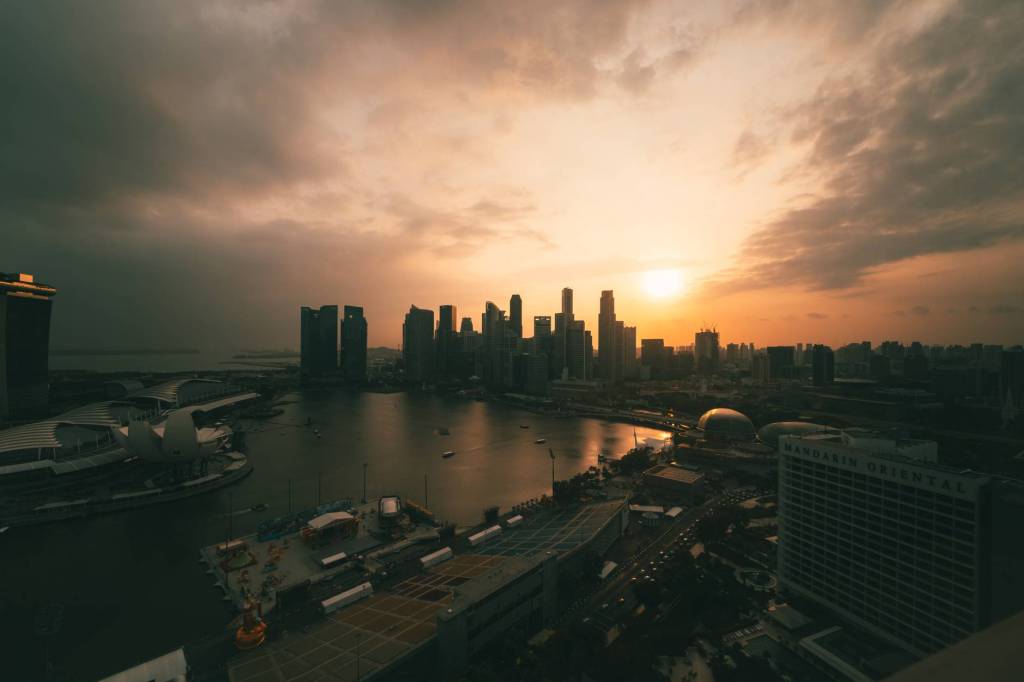
Photo: Photo of Singapore Cityscape During Golden Hour by Stijn Dijkstra available here and used under a Creative Commons Attribution. The image has not been modified.
 Hilman Hambali
Leave a comment